
Underwater Sonatas: A Journey into the Realm of Singing Fish
"Sure enough the music of “Singing Fish” could distinctly be heard below; it reminded me of the twanging in third of the G string of the violin" - Lord Holden
If the name Batticaloa is mentioned in Sri Lanka, someone is sure to ask if you’ve heard of the singing fish. Since the 18th century, fishermen have claimed to navigate by the mysterious music of the singing fish of the Batticaloa lagoon. Opinion differs whether it is a fish, or a certain mollusk, or some movement of sand, but no one denies that something—or someone—sings in that lagoon.
The lagoon is about 56 kilometers long and comprises of a wide range of mangrove swamps and coral reefs, attracting all sorts of birds and animals. Outside of the mangrove ecosystem, the lagoon is home to rare and endemic flora and fauna, and if you’re into birdwatching, the lagoon is a magnet for a range of water birds. The wetland is rich in biodiversity and highly productive for fisheries. Several thousand families depend on the lagoon fishery for their livelihoods and food security.
I was seventeen when I embarked on my first adventure in the lagoon. Adventures can take many forms, but in my case, I wanted to investigate the phenomenon of the fish that sings under water. According to local fishermen, between April and September is the best time to listen. When I mentioned the plan to my late older brother, whom I affectionately called Chinnannan, in Tamil (meaning second of the older brothers), embraced the idea and agreed to join me. As I pen down these words, my thoughts inevitably drift to my Chinnannan, a soul departed almost two decades ago in a tragic car accident. The weight of regret lingers within me, a painful reminder of the inability to attend his funeral in Sri Lanka. Circumstances tethered me to family commitments that held me back from participating in the somber final rites. Time hasn't made the pain go away, and I still feel guilty for not saying goodbye to my sibling. Remorse lingers in my memories, reminding me of the farewell I never got to give.
Chinannan told me about this fisherman, Muttu, who lived in a nearby village. Eager to embark on this exciting journey, I hopped on my bicycle the day before the planned adventure and pedaled my way to the neighboring village to seek out Muttu. It was a sultry afternoon, and it took about 10-15 minutes to get to Muttu’s place. The anticipation of what lay ahead added an extra burst of energy to my ride, and as I arrived in the village, the prospect of meeting Muttu heightened the sense of excitement for the impending adventure. I found his small hut made of brick walls and thatched roof, the white paint peeling off the front door. Muttu, in his mid-40’s, was sitting with his back to the sun at the entrance of his hut. He was a big guy, brawny with an oversized nose and a thick mustache. He was working on an old nylon fishing net sprawled in front of him. With a large needle and a small knife, he was repairing damaged sections of the dragnet, a weighted net that he drew through the lagoon to trap fish. He was getting ready for his next morning catch. After introducing myself and taking some time to explain my mission to him, he finally agreed to take me. Since he knew my brother, it was fairly easy to convince him to take me on this trip.
Having settled on a fair price of 100 rupees (equivalent to about US $0.50 cents at that time), we arranged to meet Muttu near the bridge the following night for our adventure. Concurrently, Chinannan skillfully negotiated the rental of a canoe from another fisherman residing closer to the fish market. With the night sky adorned by a full moon in May, Chinnannan proposed we take a leisurely walk to the lagoon, a mere 10-15-minute journey from our house. In the dim glow of a few streetlamps, we relied on the luminosity of the moon and an antiquated flashlight to guide our way. As we reached the agreed-upon spot along the lagoon’s shore, Muttu awaited us, casting light on the scene with a hurricane lamp. He wore a colorful checkered sarong and a long-sleeved shirt. Sarongs—comprising of a length of cotton fabric wrapped around the body below the waist and tied at the waist level, traditional attire of the fishermen, creating a sea of blue and green plaid throughout the stalls of the fish market.
It was a pleasant evening. The smell of the surrounding air was a combination of smells, a mixture of fish and frog. But, as we rode away from the shore, I could smell the freshness of the lagoon. The moon had just risen, and the lagoon was calm. The lagoon waters sprawled out in front of us—the pristine jewel of the eastern province known for its color and clarity. As a youth, I biked along its length every day on my way to my high school, counting birds as I went.
Muttu was extremely familiar with this body of water, and we relied on him to guide us to the right place. We were rowing to a spot near the famous “Elephant Rock,” where the mysterious musicians rarely fail to oblige. The silence was refreshing—the only sound we heard was the movement of our oars taking delicate dips in the water. I looked at my watch—1:30 AM. We were about two kilometers from the Batticaloa Fort. built by the Portuguese. When we reached the rock, Muttu stopped the canoe and waited for a minute or two. He then slowly dipped one end of the oar straight into the lagoon and asked me to place my ear on the other end. He assured us that this was the best way to listen. I obliged, and we all sat in silence. After a few minutes, my eyes grew wide. I could hear soft little croaks and another soft sound, like the plucking of a violin or harp strings. Seeing the clear night sky full of stars was absolutely breathtaking. We waited in silence for some time, and every few minutes, I would hold the one end of the oar to my ear to listen to these magical creatures.
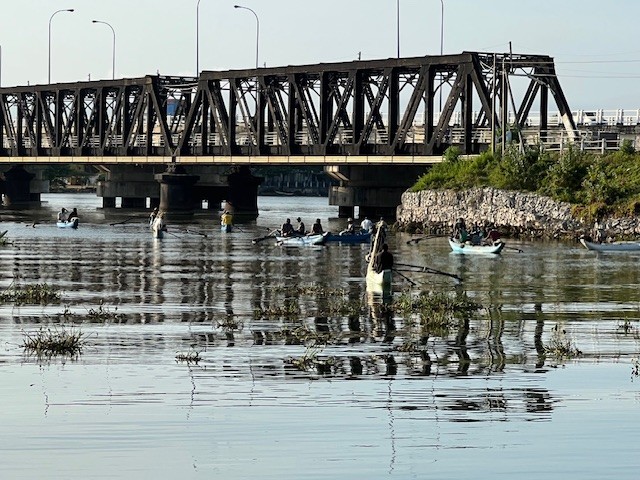
After a while, we rowed until we were underneath Lady Manning Bridge. As we rowed, I wondered about the source of this eerie underwater symphony. Various theories have been put forward. Since the 18th century, Tamil fishermen have claimed to navigate by the mysterious music and referred to it as Oorie or “hermit crab theory.” Then there is the “telegraph theory,” which explains that the sounds are produced by the wind blowing through wires and echoed by the waves. Alternatively, there is the “frog and fish theory,” which is the most popular of all theories and suggests that the sound is produced by some form of marine life, anything from catfish to mussels. Yet another theory suggests that water flowing between boulders on the lagoon floor creates the sound. Personally, I know in my mind that there is a creature singing at the bottom of the lagoon. Far too many people have heard this mysterious sound for it to be a myth. There are so many personal testimonials that this must be a solid fact, not fiction.
The English politician and traveler, Sir Emerson Tenant, arrived in (then) Ceylon in 1845 to become the Colonial Secretary. He said, “I distinctly heard the sounds, and they came from the water like the gentle thrills of a musical cord, or the faint vibration of a wine glass, when the rim is rubbed by a wet finger. It was not one sustained note but a multitude of sounds, each clear and distinct itself, the sweetest treble mingling with the lowest bass.”
In 1953, two American Jesuit priests recorded the singing fish using a homemade hydrophone. Father Lorio, a Jesuit priest who lived in Batticaloa, has been trying to understand the mystery of the singing fish since the 1950s. “I asked the fishermen for details and so one day I toured the lagoon in one of the boats, hoping to hear the fish sing. I heard a sound, and I recorded it,” said Father Lorio. Although the cleric has since misplaced the tapes of the sounds, he remains one of the main credible witnesses to the fact that the singing fish actually exists. Over the years, many researchers have tried to find out what makes the sounds and assume that it is being made by some kind of marine life, perhaps a certain kind of fish gill, but they cannot be sure of exactly what it is and where it comes from.
With the soft glow of the lantern that Muttu carried, I checked my watch, and the time displayed was 4:30 AM. In the predawn stillness, we observed fishing canoes gracefully gliding across the surface of the lagoon, commencing their daily work. The early morning light made the scene look magical and got us even more excited. We felt so peaceful and happy at that moment. Slowly making our way back to the shore, a quiet confidence enveloped us, convinced that we had been fortunate enough to witness the elusive phenomenon of the famous singing fish in the serene embrace of the lagoon.
A popular logo for Batticaloa residents is the singing fish with its tail fins curved to form a harp. Regardless of the fact or fiction surrounding this ichthyological curiosity, it has moved the local poets to give Batticaloa the nickname, meen padum theen Nadu, or “Honeyland of Singing Fish.”