
Culture or Control: Are women and girls paying the price?
Women, if the soul of the nation is to be saved, I believe that you must become its soul – Coretta Scott King
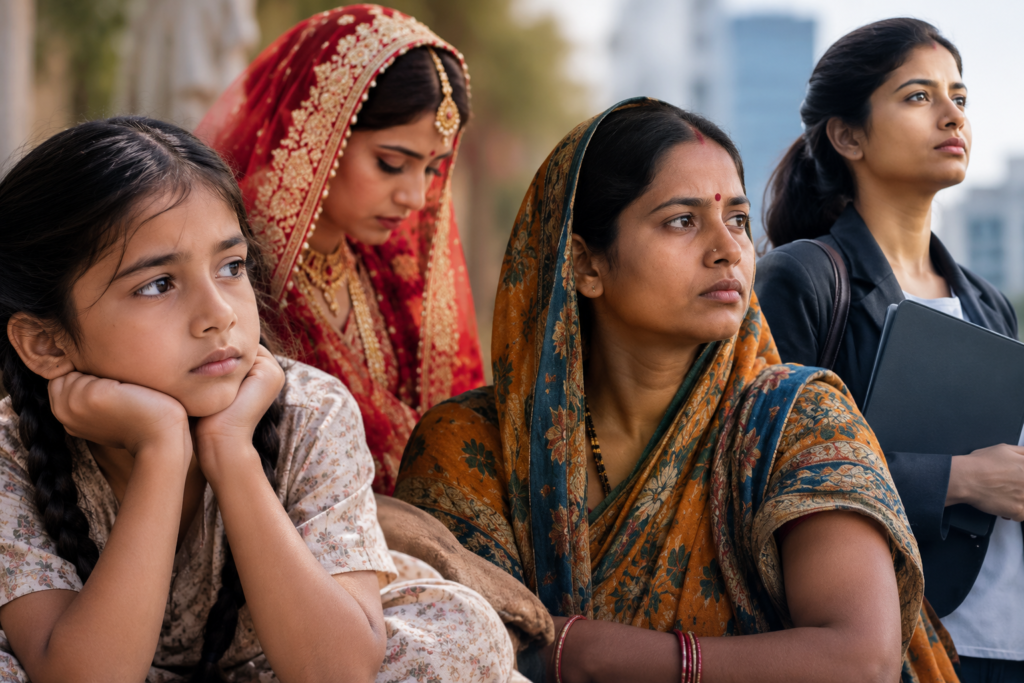
Culture can be a source of identity, belonging, and strength, but it can also become a powerful instrument of control. Across societies, traditions, customs, and social expectations have sometimes been used to define what women and girls may do, whom they may marry, how they should behave, and what roles they are expected to occupy. When such practices restrict freedom, deny opportunity, or justify unequal treatment, an important question arises: Does culture itself oppress women, or is culture being used to preserve systems of power and control? The distinction matters, because respecting cultural diversity should never require accepting practices that diminish human dignity, limit individual choice, or deny women and girls their fundamental rights. This chapter explores where the line between cultural tradition and oppression is drawn—and who has the power to draw it.
Examples of oppressive cultural practices include Patriarchy, Female genital mutilation (FGM), Child marriage, Honor killings, Dowry practices and overall restrictions on women's education, mobility, and attire. These practices are often justified as preserving identity, heritage, or religious faith, creating a conflict between cultural relativism and the principles of gender equality.
The very term “patriarch” stems from the Greek word patriarkhēs, meaning “father” or “chief of the race,” encapsulating the idea of the father as the ultimate authority. The culture of patriarchy refers to a social system in which men hold primary power, dominating in roles of leadership, moral authority, social privilege, and control over property. This system often extends to various institutions such as family, education, religion, and government. The culture of patriarchy perpetuates gender inequalities, normalizing male dominance and female subordination in both overt and subtle ways. It thrives on traditional gender roles, reinforcing the idea that men are inherently more suited for leadership and decision-making, while women are relegated to nurturing and supportive roles.
I grew up in a household where my father’s voice carried immense weight, his opinions shaping the course of our daily lives. While not every decision rested solely in his hands, when he spoke, his words held a quiet finality that few dared to challenge. His authority was deeply embedded in our family structure, influencing our experiences, particularly during our formative years. This dynamic reflected a broader cultural tradition rooted in the Tamil community of Sri Lanka and mirrored patriarchal systems that have long existed across the world.
Within our home, this framework manifested in clearly defined roles and expectations. My father was the cornerstone of decision-making, embodying stability and guidance. His vision for our family was unwavering, and my mother, his devoted partner, stood by his side, supporting his choices with steadfast commitment. She assumed the role of caregiver and emotional anchor, ensuring the household functioned harmoniously and nurturing the familial bonds that sustained us. Her presence softened the rigid structure of our traditional setup, offering a compassionate counterbalance to my father’s authority.
Looking back, I see how ingrained gender roles shaped our family’s dynamics. My father was the economic provider, the one who ensured our material security, while my mother nurtured us emotionally, embodying care and compassion. This division, though stabilizing, also imposed constraints, limiting individual expression within narrow definitions of masculinity and femininity. The societal framework dictated expectations, reinforcing distinct attributes and responsibilities for men and women, shaping not only our actions but also our understanding of identity and potential.
Yet, despite these rigid norms, our family was bound by love and mutual respect. My brothers and I cherished our sister, balancing protectiveness with affection, while my mother’s influence provided a sense of warmth amid the patriarchal structure. The interplay between my sister, my mother, and the rest of us fostered a unique harmony, tempering the undertones of male dominance with an enduring sense of unity.
As I reflect on those years, I appreciate the love that wove us together even as I recognize the limitations imposed by the societal norms we lived within. This awareness serves as a reminder of the importance of challenging traditional expectations, creating spaces where everyone—regardless of gender—can explore and fulfill their potential beyond prescribed boundaries.
The perception of women as inferior to men was deeply embedded in many aspects of ancient Chinese culture, particularly within the Confucian social and philosophical tradition. These attitudes are reflected in the Five Classics, a foundational body of texts traditionally associated with Confucian thought and attributed, in part, to Confucius. Although the Five Classics encompass a wide range of subjects and do not present a single, uniform view of women, passages within the tradition contributed to an understanding of women as subordinate to men and primarily defined by their roles within the family and household. As Richard W. Guisso observes in his study of women in early China, traditional texts contained perceptions of women that helped shape broader assumptions about their character and social position. Such views not only shaped individual perceptions but also laid the foundation for a societal structure that perpetuated women’s subjugation.
In traditional Chinese and Indian societies, family structures were largely organized around patrilineal and patriarchal traditions, in which family lineage, inheritance, and social identity were typically traced through the male line. Daughters were often expected to leave their parental homes when they married and become members of their husbands’ families. Marriage could therefore represent not simply the formation of a new household, but a transfer of a woman’s primary familial obligations from her parents to her husband and his relatives. Within this system, wives were frequently expected to manage household responsibilities, bear and raise children, and care for their husbands and aging in-laws. A woman’s status and security could be closely tied to her relationship with the men who held authority within the family—first her father, then her husband, and eventually, in some circumstances, her sons. These expectations could leave women with limited control over important decisions affecting their education, marriage, finances, mobility, and personal lives. Although such traditions varied considerably across regions, communities, religions, and historical periods, they illustrate how cultural norms can reinforce gender hierarchies when obedience, family duty, and male authority are valued above women’s autonomy and equal participation.
Indian society, like many classical societies, has long been shaped by patriarchal structures. Patriarchal values governing sexuality, reproduction, and social relations have been expressed not only through formal rules and institutions but also through cultural metaphors, symbolism, and everyday rituals and practices. Historically, overt laws and social rules explicitly restricted women’s participation in public life and denied them rights that men took for granted. Yet patriarchy has also been sustained through subtler and more pervasive means: the cultural narratives, symbols, ideals, and traditions through which societies define what a “good” woman should be. Stories, legends, religious imagery, and popular traditions have often celebrated women for qualities such as purity, obedience, modesty, self-sacrifice, and devotion to family. In some cultural settings, the ideal woman is portrayed as one who willingly places the needs of her husband, children, or family above her own aspirations. Rituals and social expectations can reinforce these ideals by associating femininity with dutiful wifehood, selfless motherhood, and unquestioning service to others. Such expectations may appear to honor women, even while limiting their autonomy and defining their worth primarily through their relationships and responsibilities to others. In this way, cultural traditions can perpetuate gender hierarchies without relying on explicit laws or coercion: inequality becomes embedded in the very ideals that society teaches women and girls to admire and emulate.
The roots of this disparity can be traced to ancient cultural and religious texts that perpetuate patriarchal norms. The Laws of Manu, written around 200 BCE, codified gender inequality. Women were instructed to revere their husbands unconditionally, as illustrated by the decree: “Though destitute of virtue or seeking pleasure elsewhere, or devoid of good qualities, yet a husband must be constantly worshipped as a god by a faithful wife.” Conversely, women who defied their husbands were subjected to severe punishments, with one law stating: “If a wife, proud of the greatness of her relatives or [her own] excellence, violates the duty which she owes to her lord, the king shall cause her to be devoured by dogs in a place frequented by many.” Such laws and cultural norms have long influenced societal attitudes, perpetuating the subjugation of women and the prioritization of male heirs. While legal and religious efforts to challenge these inequities are ongoing, they face formidable resistance from entrenched traditions and economic pressures, underscoring the need for sustained advocacy and cultural transformation.
Historical legal and religious texts provide important evidence of how societies have sometimes institutionalized expectations concerning women’s obedience, sexuality, and marital conduct. Modern honor killings represent a very different phenomenon, but they can similarly arise when family reputation becomes closely tied to the control of women’s behavior.
“Let me be clear: sexual violence is not cultural—it is criminal. Women’s rights are human rights, and there is no room for culture in that discussion. Culture must never be accepted as an excuse for the oppression of women,” declared Margot Wallström, former Swedish Foreign Affairs Minister. Expanding on her stance, Wallström explained, “Culture, as defined by sociologists, is a set of values, norms, and beliefs shared by a group. It could refer to the traditional practices in Afghanistan, the fervor of football fans in Argentina, or the behaviors of university students in Sweden. When I speak of the ‘oppression’ of women, I refer to any situation where a woman is restricted or marginalized because of her gender—whether through explicit legal discrimination or implicit societal attitudes that devalue and diminish her worth.”Wallström’s assertion underscores the imperative to distinguish between cultural practices and human rights, emphasizing that no cultural tradition can justify the marginalization or mistreatment of women. Her words highlight the universal need to challenge gender-based inequalities, wherever they exist.
Many advocates defend oppressive practices, often rooted in tradition, as essential to community identity. They argue that cultural practices are crucial for preserving this identity. However, culture is not static; it has continually evolved alongside societal progress. Abolishing harmful traditions does not erase identity but rather enhances the well-being of individuals within the community. Furthermore, some traditional elders often dismiss gender equality as a Western concept, overlooking the universal nature of human rights and the indigenous movements within various cultures that advocate for change.
The Universal Declaration of Human Rights (UDHR) establishes the principle that all human beings are born free and equal in dignity and rights, and that these rights apply universally without discrimination, including on the basis of sex, religion, national or social origin, or other status. Thus, while cultural traditions and practices deserve recognition and respect, cultural differences cannot by themselves justify denying individuals their fundamental human rights .
However, the principle of cultural relativism suggests that rights and ethics can vary by culture, leading to tension between respecting diversity and combating oppression. Striking a balance between honoring cultural diversity and upholding human rights presents one of the most significant ethical challenges in global governance.
CONCLUSION
Culture, in itself, is not oppressive; rather, its impact depends on how it is practiced and interpreted. By redefining cultural values to prioritize inclusion, dignity, and equality, societies can evolve while preserving their heritage. Leaders, in collaboration with the community, can reinterpret or replace harmful traditions with equitable alternatives. Cultural discussions must center on women’s voices, ensuring that culture is never used to justify oppression. Instead, it can serve as a powerful tool for empowerment, identity, and progress. By eliminating oppressive practices and embracing equitable traditions, societies can honor their heritage while upholding universal principles of justice and human rights. True cultural preservation lies not in clinging to harmful norms but in fostering an environment where every individual—regardless of gender—can thrive.
Challenging the culture of patriarchy requires collective effort and a shift in societal mindset. Education and awareness are critical in dismantling the stereotypes and biases that uphold patriarchal norms. Advocacy for equal opportunities, legal reforms to address gender-based violence, and the amplification of marginalized voices are essential steps toward creating a more inclusive and equitable society. By recognizing the pervasive influence of patriarchy and actively working to dismantle its structures, societies can move closer to achieving true gender equality.